Parallel Realities: One Investigation. Multiple Perspectives. How the Past Can Impact the Present.
Author’s Note
References to police reports, investigative findings, and excerpts throughout this article are taken from my Columbia Police Department case file, including investigative reports prepared during the investigation, along with my own memories and reflections. Some names and addresses have been redacted to protect the privacy of friends mentioned in the reports. If they are ever comfortable sharing their perspectives, I would be honored to include their voices in the future.
For years, I believed I understood the story of the days that changed my life because I lived them.
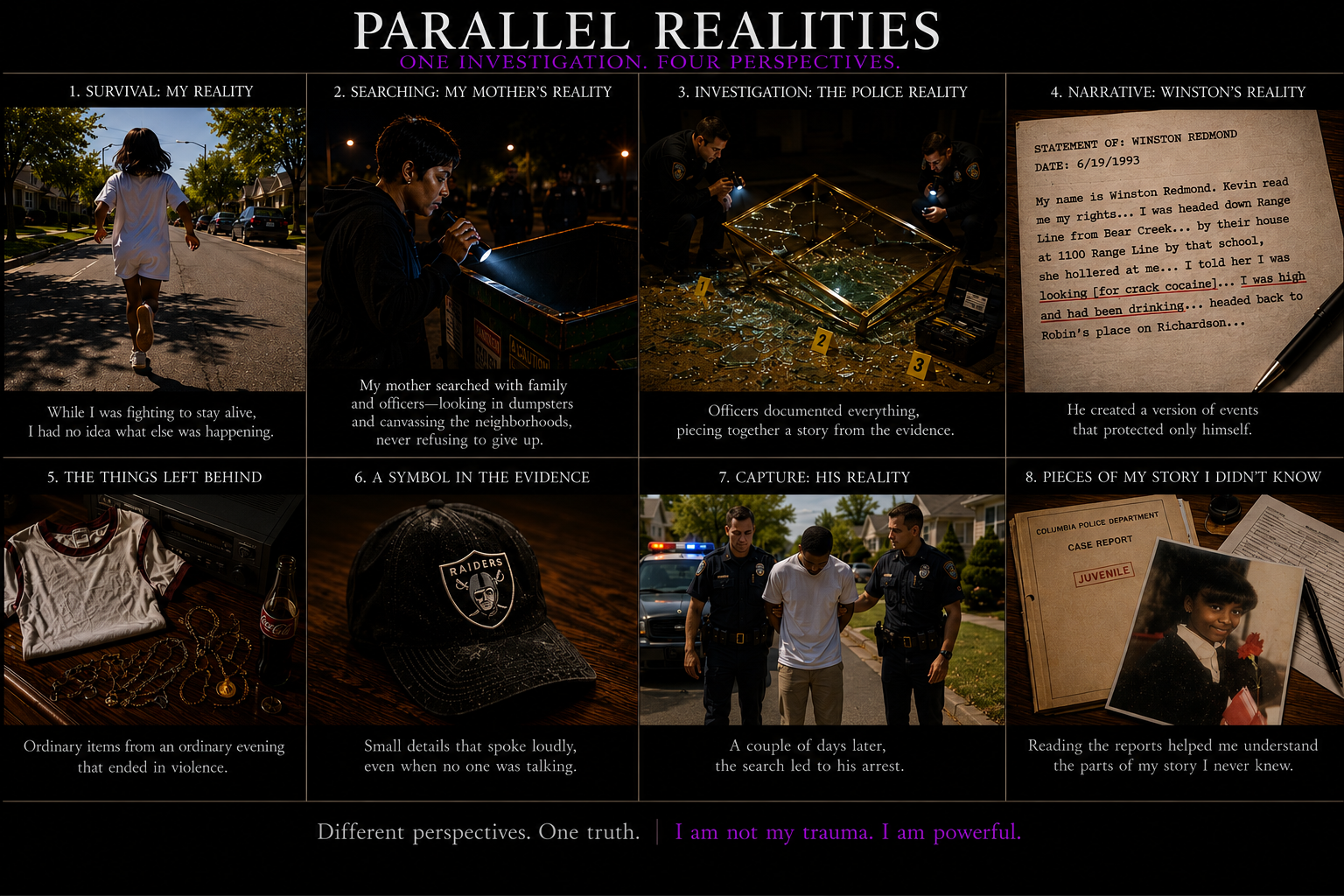
While I was fighting to survive, my world became very small. Every thought was focused on staying alive and finding a way home. I wasn’t thinking about what was happening outside of the home I was trapped in or what was unfolding back in my neighborhood. Survival didn’t leave room for anything else.
What I didn’t realize was how much was going on beyond what I could see.
When I requested a copy of the police reports in 2006, I thought I was searching for one missing piece, the name of the woman who stopped her car, opened her door to a frightened, partially clothed, barefoot fourteen-year-old girl, and drove me home to safety. I had wanted to thank her for years but never knew her name.
Finding Donna became one of the greatest gifts to come from those reports.
But the reports gave me so much more than a name.
They uncovered parts of my story that I had never had the opportunity to witness. They gave me a clearer understanding of everything that had been happening while I was simply trying to survive, and in doing so, they brought a sense of clarity and closure I never expected to find.
Survival: My Reality
During my kidnapping, my focus never changed. I wanted to live.
Every decision I made was centered on returning to my mother. I wasn’t thinking about investigations, crime scenes, evidence, or search efforts. I simply wanted to make it home.
That is why reading the reports over a decade later was such a profound experience. They showed me what had been happening while I was fighting for my life.
Searching: My Mother’s Reality
While I was missing, my mother refused to stop looking for me.
The reports describe officers responding to our home after midnight. Family members gathered. Friends of the family joined the search. Officers searched the neighborhood, dumpsters, checked yards, and canvassed the area. At one point, my mother followed what she believed might be an important lead after learning about a black Raiders cap found inside our home. Believing it belonged to someone she knew, she went with relatives to a friend’s house hoping she would find answers.
Reading those pages allowed me to see my mother’s determination from a perspective I never could have understood at that time, but understand now since becoming a parent.
While I was desperately trying to get home, she was doing everything she could to find me.
Investigation: The Police Reality
The officers were seeing something entirely different.
One report begins:
“On June 19, 1993, at approximately 12:00 a.m., I was contacted at my residence by Sergeant Schwandt… Sergeant Schwandt requested that I respond… and determine if an evidence technician was going to be needed.”
That detail alone stood in sharp contrast to Winston’s account.
If his version of events had been true, there would have been little reason to preserve our home as a crime scene.
Instead, officers documented evidence of what appeared to be a violent struggle.
The reports describe shattered picture-frame glass just inside the doorway, a brass-framed glass end table overturned with broken glass scattered across the floor, furniture pushed out of place, and broken decorative items. It was obvious that there had been a physical struggle.
The broken glass from the large picture never left my memory, because I had been strangled on top of it.
Reading about that night from the view of the detectives helped me understand the magnitude of the violence that occurred that evening. Even still, the report indicates that there was nothing to indicate that I had been injured during the struggle.
One officer reported that the VCR had not simply disappeared. Its cables had been carefully unscrewed, and it had been unplugged from the power source without disturbing the small decorative items that surrounded it. Officers found my T-shirt folded over the arm of the couch near the doorway. My necklaces were still lying on the coffee table with their clasps intact. An open bottle of soda remained beside them.
Ordinary objects from an ordinary evening had suddenly become evidence.
Narrative: Winston’s Statement
Winston’s statement presents a very different version of events.
Rather than paraphrase it, I believe it is important to allow readers to see his words exactly as they were written.
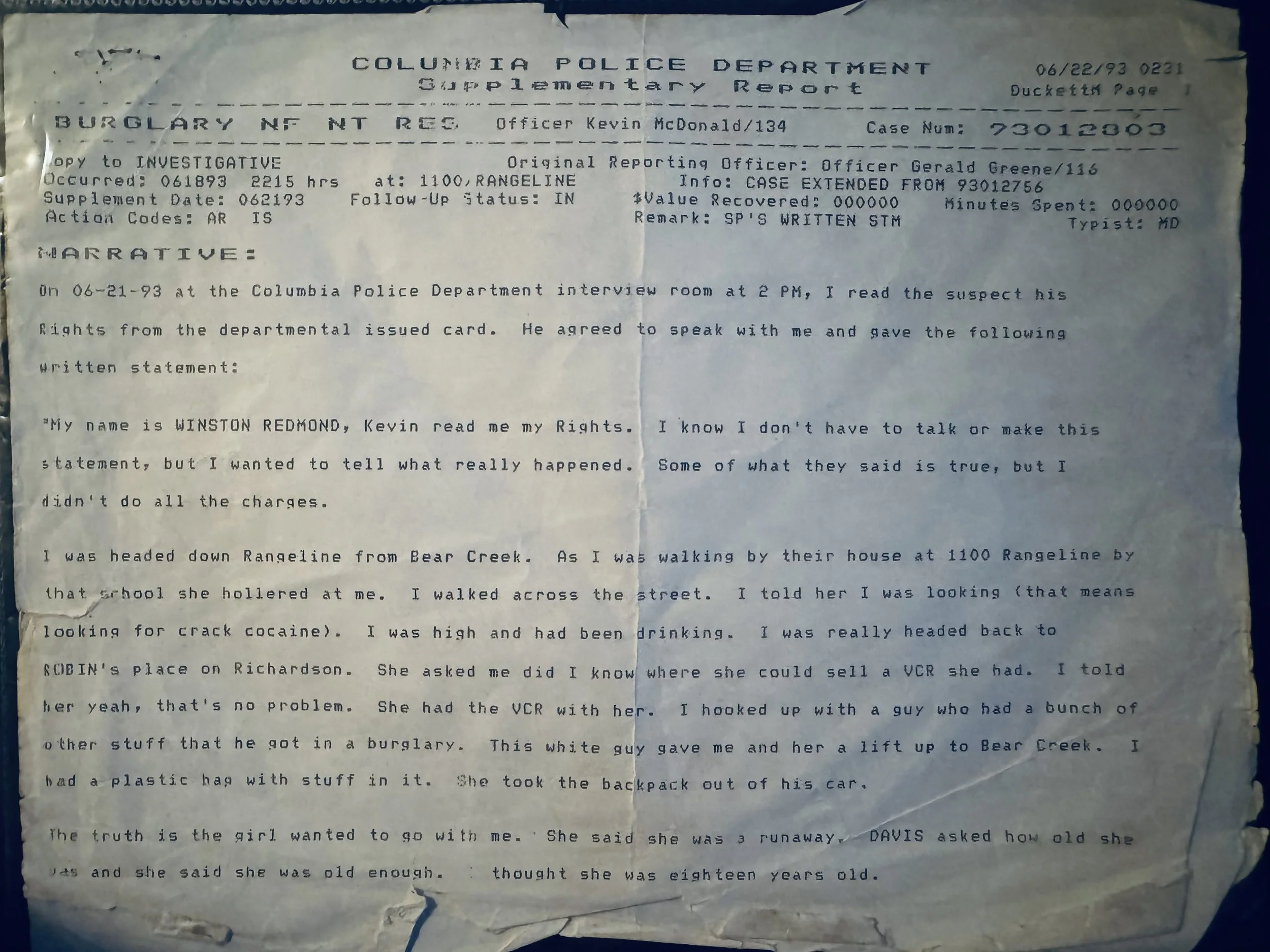
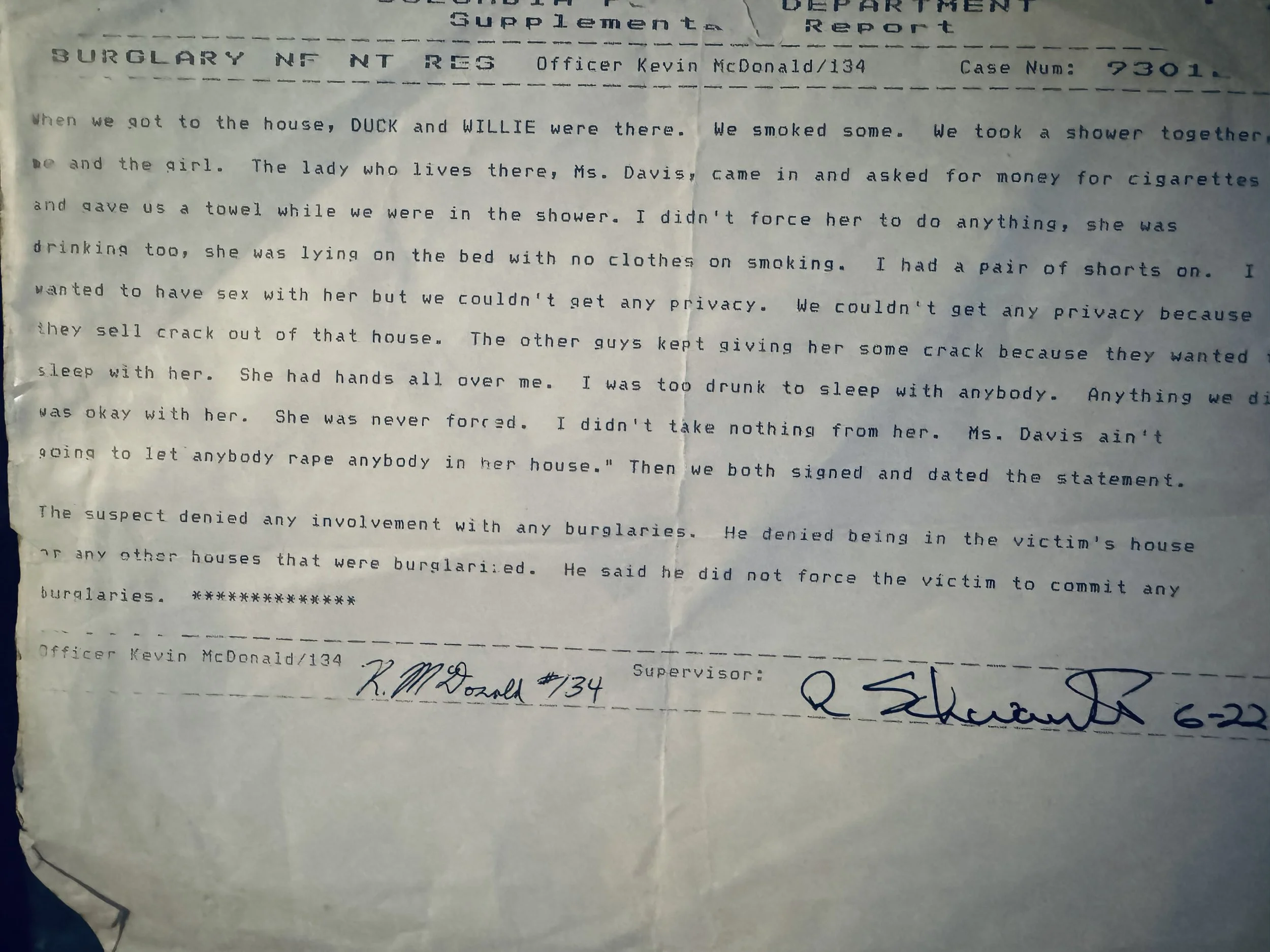
Nothing that he said about me or my actions were true.
As I compared his words with the documented condition of our home, the contrast is impossible to ignore.
His narrative attempted to portray consent and me being a willing participant.
The evidence stated otherwise.
The Things Left Behind
One of the most emotional parts of reading the reports was the ordinary things that I left behind.
The shirt I had worn that evening.
My necklaces.
My soda.
The VCR.
Those details reminded me that my evening had begun like any other.
Those items became silent witnesses to a life interrupted.
One of the reasons I was so excited to stay home that evening was because I wanted to record Drop Dead Fred. It was one of my favorite movies. I had the VCR set up and a VHS tape ready.
I never got the chance.
Winston had demanded that I unplug the VCR because he wanted to steal it.
Years later, reading the police reports and seeing the officers document that same VCR brought me back to that moment. It wasn’t just another piece of evidence. It was a reminder of the ordinary Friday night I thought I was going to have, and how quickly everything changed.
[See officer reports at the end of the article]
A Symbol in the Evidence
For years, I didn’t know there had been a black Raiders cap found inside our home.
Believing she recognized who the cap might belong to, my mother followed that lead with hope that it would bring her closer to finding me.
It became another reminder that while I was missing, countless decisions were being made in an effort to bring me home.
Capture
The days between my escape and Winston’s arrest were filled with pure terror. Returning home didn’t immediately bring a sense of safety because he was still free. A couple of days later, the search led to his capture and arrest.
I will share more about his capture and the officers’ reports in a future article.
The Child Who Had to Defend Herself
Due to Winston’s statement and the examination of my journal, I found myself defending my own credibility.
Two of my friends were subpoenaed.
My character was questioned.
I was viewed as a possible runaway.
I remember sitting in that courtroom watching him smile beside his attorney.
I also remember struggling through my testimony. Because of my emotional state, my prosecuting attorney told me they were going to accept a plea agreement instead of going to trial. Looking back, I understand why that decision may have been made. The criminal justice process can be overwhelming for anyone, especially a child.
I had to answer questions about my behavior while the adult who kidnapped and assaulted me offered an entirely different version of events.
That experience taught me something I now understand many survivors face.
When your credibility, your private writings, your friendships, and your character all become part of the case, it can feel as though you are being asked to prove not only what happened, but that you deserve to be believed.
Sometimes surviving the crime is only the beginning.
Sometimes survivors are also asked to defend the truth.
What I See Now
A few statements attributed to me in the reports are things I do not specifically remember saying, mainly because they do not match my memory of events.
That observation is not meant as criticism of the officers involved. If anything, it has given me a greater appreciation for how difficult their job can be. The reports were written by people trying to document information from a traumatized child during an active investigation. They were working with the information available to them at the time and doing their best to preserve details that might later become important.
It also reminded me of the importance of the accuracy of the documentation. Whenever possible, survivors should review reports, ask questions, and seek clarification if something does not seem right.
These reports are invaluable records, but they are still created by human beings documenting events involving other human beings during moments of crisis. Errors can be made.
As I continued reading, I found myself noticing the names of officers and detectives throughout the file. I do not remember any of them personally, but I can see their efforts. I was able to join them throughout their journey of trying to find out what happened, preserve evidence, and follow leads.
That is one of the reasons I care so deeply about speaking to future law enforcement officers today.
Every report represents a real person. Every interaction can either help someone begin to heal or cause further harm. In the end, the reports did more than document evidence.
I am grateful for their work and support of my family, the determination of my mother, the love and prayers of family and friends, and Donna, a Good Samaritan who did not hesitate to drive me home.
Reflections
When I speak to future officers at the San Diego Regional Police Academy, I am sharing my story as a survivor and as someone who has now seen an investigation through the eyes of the people who responded, documented, searched, and worked to reconstruct what happened. Those pages are more than paperwork.
I am grateful that my therapist encouraged me to request the reports, however, I wish I had my complete investigative file, including evidence photos, recordings, and my mother’s 911 call, all of which has since been destroyed.
Beyond the Investigation
I’ve come to understand that trauma doesn’t always end when the investigation ends.
Sometimes it quietly influences decisions decades later.
Several years ago, I considered pursuing legal action in an unrelated matter. There was substantial documentation supporting what had happened, and I sought legal counsel to understand my options.
One of the first things I was told was that if the case moved forward, my history would likely become part of the litigation. My past trauma, treatment history, and other aspects of my life could all become part of the case. The suggestion was that my previous experiences might be used to explain why I was so deeply impacted by the situation I was facing.
I also discussed this situation with my psychiatrist. She also emphasized the importance of continuing to follow my treatment plan because of the fact that it could become part of the legal process.
In the end, I chose not to move forward.
That decision wasn’t because the evidence wasn’t there.
It was because I understood what it meant to once again have my history examined. It made me realize that the fourteen-year-old girl who sat on the witness stand never completely disappeared.
Experiences like that don’t simply become memories.
They become part of the framework through which we evaluate future decisions, including whether we are willing to place our lives under that level of scrutiny again.
That is one of the lasting impacts of trauma that people don’t often see.
In spite of the outcome, I don’t regret using my voice. I regret allowing fear and the anticipated emotional toll to determine what came next. Today, I choose differently. I intend to continue using my voice, not only for others, but for myself.
There is still more to uncover. I find that there is beauty in connecting the dots between the past and the present. If nothing else, I am learning more about myself.
And I look forward to sharing those discoveries, one piece at a time.
To learn more about LaDonna Renee VST Foundation, Inc. and our mission, visit www.findyourvoicevst.org or become a subscriber on Substack.
You can also follow me on Facebook by searching LaDonna Renee VST Foundation Inc., and visit me on Instagram and TikTok for additional stories, updates, and Reels. Thank you for walking beside me during the second half of my journey! Stay tuned for more insight on my case.
To see copies of the evidence reports visit: https://open.substack.com/pub/ladonnarenee/p/parallel-realities?r=6tzv5j&utm_medium=ios